


A great deal of gynecology that once meant a hospital scheduling department, a pre-op appointment and a day of general anesthesia now happens in an exam room in under an hour. That is a real improvement, but it comes with a catch: procedures that are quick for the practice are not automatically comfortable for the patient, and the difference between the two comes down entirely to how the visit is run.
Here is what we do in the office, what each procedure is for, and what it actually feels like.
Why in-office matters
Beyond convenience, keeping these procedures in the office means no facility fee, no anesthesia recovery, no separate scheduling, and — most usefully — the person performing the procedure is the person who knows your history and who will call you with the results. Continuity is not a luxury in a diagnostic workup. It is what keeps things from getting lost.
Colposcopy
Why it is done
Almost always to follow up an abnormal Pap smear or a positive HPV test, occasionally to evaluate a visible cervical abnormality or unexplained bleeding. It is worth repeating clearly: an abnormal Pap usually means cell changes, most often caused by HPV, and a large share resolve without treatment. Colposcopy is how we tell which is which.
What happens
You are positioned as for a Pap. A speculum is placed, and a colposcope — a magnifying scope on a stand — is used to examine the cervix. It stays outside your body and never touches you. A dilute vinegar solution is applied, which makes abnormal areas turn white and briefly stings a little. If an area looks suspicious, a small biopsy is taken.
What it feels like
The examination is comparable to a Pap. The biopsy, if one is needed, produces a brief sharp pinch or a strong cramp for a few seconds. An NSAID an hour beforehand helps meaningfully; Pro-Nox is available. Expect light bleeding and possibly a dark discharge for a few days afterward — that is from the solution used to stop bleeding at the biopsy site.
Results
Usually one to two weeks. Depending on what comes back, the plan may be simple monitoring with a repeat test, or a treatment procedure to remove the abnormal area. We will walk you through what the result means rather than leaving you to interpret a portal message.
Hysteroscopy
Why it is done
To look directly inside the uterine cavity, which no imaging study can do as well. Common reasons include abnormal or postmenopausal bleeding, suspected polyps, a fibroid that may involve the cavity, recurrent pregnancy loss, an IUD with strings that cannot be located, or an unclear finding on ultrasound.
What happens
A thin lighted scope is passed through the cervix into the uterus, and sterile fluid gently distends the cavity so the walls can be seen clearly. Modern diagnostic scopes are narrow, which is what makes office hysteroscopy practical. Local anesthetic is used at the cervix. Small polyps can sometimes be removed in the same sitting. Where the problem is more involved than the office allows, the same procedure is done in the operating room — see robotic and minimally invasive surgery.
What it feels like
Most women describe moderate cramping, similar to a strong period cramp, lasting through the procedure and easing quickly afterward. It typically takes five to ten minutes. Timing it to the week after your period, when the cervix is more cooperative and the lining thinnest, makes it easier.
When the office is not the right setting
Larger polyps or fibroids requiring operative removal, cervical stenosis that will not allow passage, or a straightforward preference for being asleep — all reasonable, and all arrangeable.
Diagnostic ultrasound
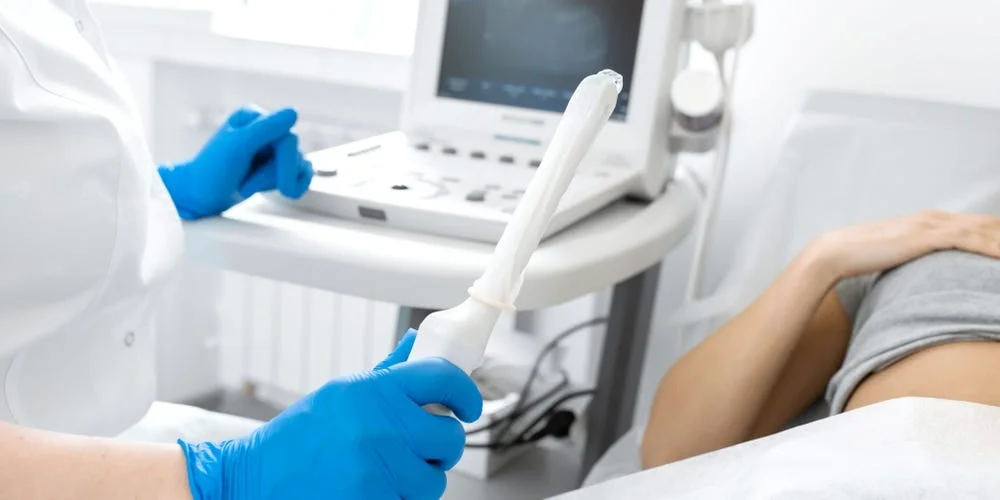
We perform pelvic ultrasound in the office, which means the scan happens during the visit and we review the images with you before you leave, rather than sending you to an imaging center and waiting a week for a report to arrive.
It is the first-line study for pelvic pain, abnormal bleeding, fibroids, ovarian cysts, and evaluating the uterine lining. One important limitation, worth stating plainly: a normal pelvic ultrasound does not rule out endometriosis, because the most common form of the disease is not visible on it. We also offer elective preventative ultrasound* — carve-out service, see the Products & Services Disclaimer at the bottom of this page for women who want proactive screening.
Comfort, and Pro-Nox
Gynecologic procedures have a long history of being described as producing "mild discomfort" by people not experiencing them. We would rather offer options than adjectives.
- Pro-Nox — self-administered nitrous oxide you control yourself. Effective within a few breaths, gone within minutes, and most women drive themselves home.
- Local and topical anesthetic, including a paracervical block where appropriate.
- Pre-medication guidance — what to take and when, so it is actually working by the time the procedure starts.
- Time. Appointments are not compressed, so nothing has to be rushed, and we can stop when you need to.
Booking and cost
Procedures are billed to insurance in the usual way. If you are uninsured or prefer to stay out of insurance, our self-pay page lists transparent pricing so you know the cost before scheduling.
Book an appointment or call 813-733-7300. We see women from Lutz, Wesley Chapel, New Tampa, Land O' Lakes and across Tampa Bay.
This article is for general education and is not a substitute for individual medical advice. Treatment decisions depend on your full history — please talk with your own provider.